24
Oct
2026
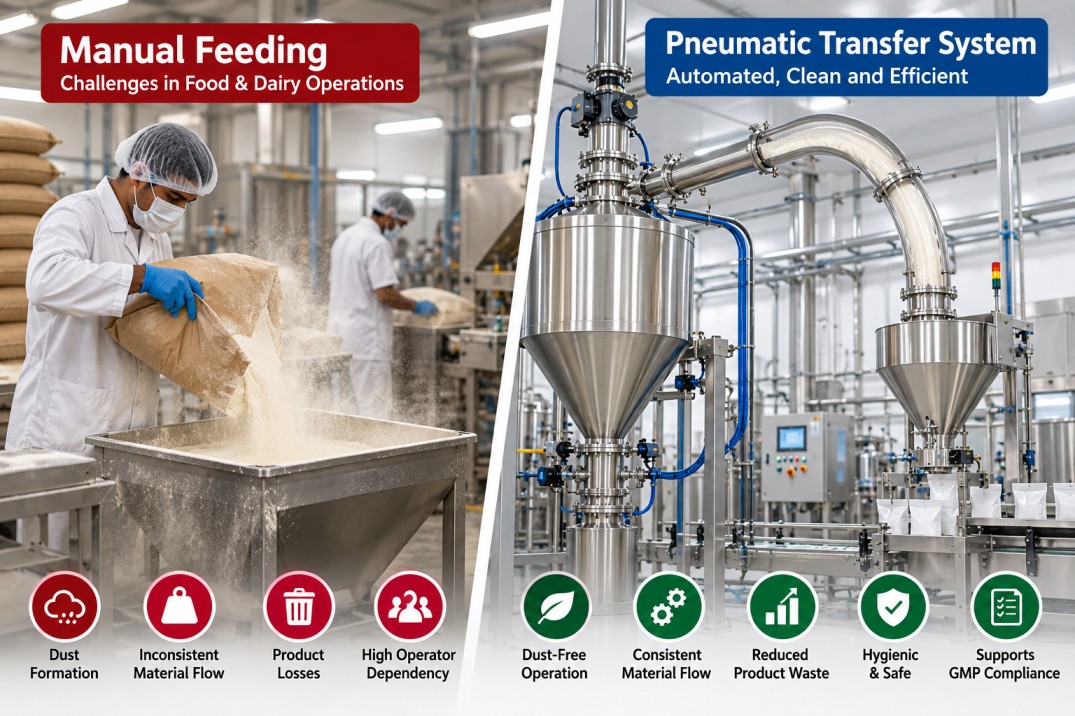
In today's competitive food and dairy manufacturing industry, operational efficiency, product quality, and hygiene are essential. Manual feeding systems can create challenges such as dust formation, inconsistent material flow, product wastage, and increased operator involvement.
Pneumatic transfer systems offer an automated alternative by transporting powders and granular materials through enclosed pipelines. For food and dairy manufacturers, this technology can help improve material handling, maintain cleaner production environments, and support consistent packaging operations.
Manual feeding systems can become increasingly inefficient as production volumes grow. Handling fine powders such as seasoning blends, flavouring agents, nutritional supplements, and dairy ingredients can introduce several operational challenges.
Manually transferring powders can release airborne particles into the working environment. This creates housekeeping challenges and may increase the risk of cross-contamination between products.
Food processing facilities must maintain appropriate hygiene standards throughout production. Dust control is therefore an important consideration when selecting material handling equipment.
Modern packaging lines require a consistent supply of materials to maintain production efficiency. Manual feeding can result in fluctuations in the quantity and timing of material supplied to packaging equipment.
These variations may contribute to inconsistent package weights, product giveaway, and production interruptions.
Every manual handling and transfer point creates an opportunity for spillage. Over time, these losses can increase material costs and require additional cleaning.
Reducing unnecessary handling points can help manufacturers improve material utilisation and streamline production workflows.
Manual feeding requires ongoing operator involvement. Fatigue, differences in handling practices, and interruptions during extended production runs can affect consistency.
Automation can reduce repetitive handling tasks and allow employees to focus on production monitoring and other operational responsibilities.
Maintaining a hygienic production environment requires appropriate cleaning procedures, contamination controls, and documented processes.
Manual material handling can make these activities more difficult when powders accumulate around feeding stations, containers, and transfer points.
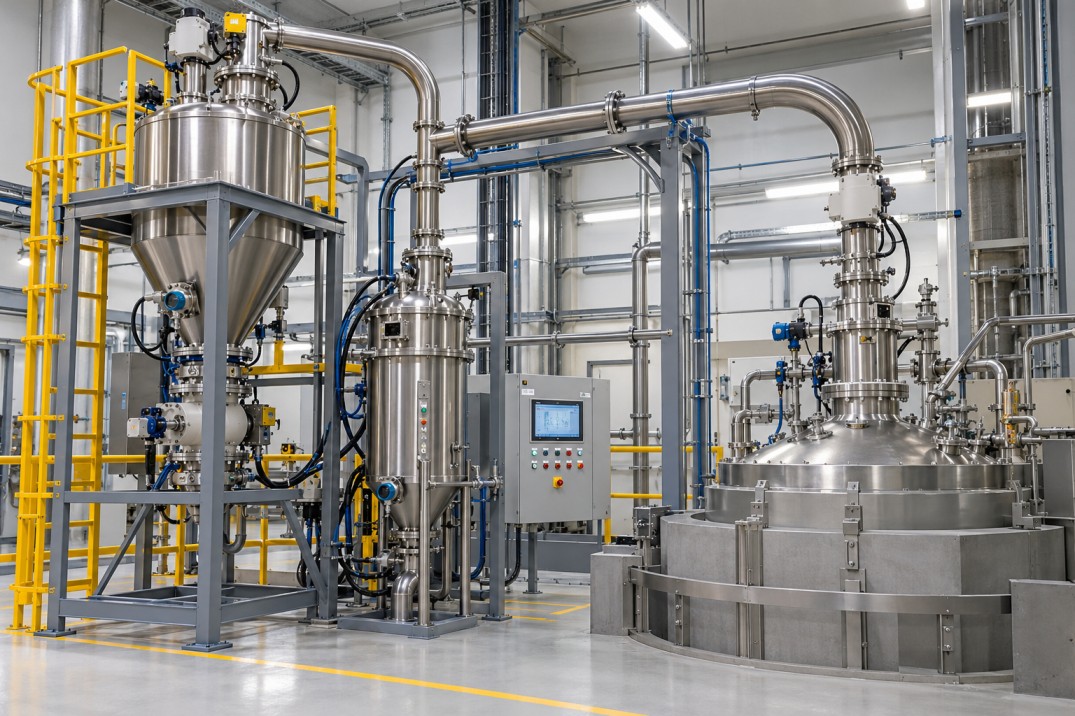
A pneumatic transfer system is an industrial material handling solution that uses moving air or another suitable gas to transport powders and granular materials through pipelines.
Depending on the application, these systems use positive pressure or vacuum conveying to move materials from a storage container or feeding station to a destination such as a mixing vessel, processing machine, or packaging hopper.
Unlike open manual transfer methods, pneumatic conveying keeps the material within an enclosed pathway during transportation.
A typical system may include:
Material feeding equipment.
Pneumatic conveying pipelines.
A blower or vacuum source.
Filtration and separation equipment.
Receiving hoppers or storage vessels.
Sensors and automated control systems.
The system configuration depends on material characteristics, conveying distance, required capacity, and the production facility's operating conditions.
Pneumatic transfer systems replace repetitive manual material movement with an engineered conveying process. This can help food and dairy manufacturers improve hygiene, consistency, and production efficiency.
One of the main advantages of pneumatic conveying is its enclosed material transfer pathway.
Powders move through pipelines rather than being repeatedly exposed to the surrounding environment during manual handling. When appropriately designed and maintained, the system can reduce dust release and simplify housekeeping.
This is particularly useful for applications involving fine ingredients, powdered food products, and dairy processing materials.
Automated conveying can provide a more controlled material supply to downstream equipment.
By coordinating the transfer process with packaging line requirements, manufacturers can reduce interruptions associated with manual feeding and improve consistency in production operations.
Actual flow-rate accuracy depends on the selected equipment, material properties, and control configuration.
Enclosed pipelines minimise the number of open transfer points where material may escape.
Direct transfer from a designated source to a receiving hopper can reduce handling-related losses and cleaning requirements. The extent of waste reduction depends on the original process and the design of the new system.
Automating material transportation can reduce repetitive lifting, pouring, and carrying tasks.
This may improve workflow efficiency and reduce operator exposure to airborne powders, subject to the effectiveness of the system's containment and workplace controls.
Pneumatic conveying systems can be designed to supply materials directly to mixers, blenders, processing equipment, and packaging hoppers.
Their pipeline-based design also provides flexibility when routing materials through facilities with limited floor space.
Pneumatic transfer technology can be suitable for various powders and granular materials used in food manufacturing, provided that the system is designed around the specific product and hygiene requirements.
Common applications include:
Food processing
Seasoning and spice powders.
Flour and other suitable powdered ingredients.
Sugar and powdered sweeteners.
Food additives and flavouring agents.
Nutritional powder blends.
Dairy processing
Milk powder.
Whey powder.
Suitable powdered dairy ingredients.
Nutritional and fortified powder blends.
Material properties vary considerably across these applications. Moisture sensitivity, particle size, bulk density, abrasiveness, and the risk of product degradation should be evaluated before selecting a conveying system.
Good Manufacturing Practices (GMP) help food manufacturers maintain appropriate production hygiene, product quality, and contamination controls.
A properly designed pneumatic transfer system can support these objectives through enclosed conveying, controlled material movement, and standardised operating procedures.
Important considerations include:
Enclosed transfer pathways can reduce opportunities for material exposure during transportation. Equipment design must also address potential contamination from seals, filters, residual product, and shared pipelines.
Food and dairy applications may require accessible components, validated cleaning procedures, or clean-in-place (CIP) capabilities where appropriate.
The selected cleaning method should match the product characteristics and the facility's hygiene requirements.
Sensors and control systems can help monitor operating conditions such as conveying pressure, system status, and material transfer cycles.
Where required, recorded operating data can support process documentation and internal quality assurance.
Product-contact surfaces and seals should be selected for compatibility with the material being conveyed and the applicable food-contact requirements.
Important: A pneumatic transfer system does not automatically establish GMP compliance. Compliance depends on the complete equipment design, cleaning procedures, facility controls, and applicable regulations.
Successful implementation requires an assessment of both the material and the existing production process.
Particle size, bulk density, moisture content, flowability, and product fragility influence system selection and conveying performance.
The system should be designed around the quantity of material required by the production line, including peak demand and operating schedules.
Horizontal distance, vertical elevation, bends, and the number of receiving points affect system performance and energy requirements.
Suitable filtration and air separation arrangements help control residual particles and maintain appropriate discharge conditions.
The system should integrate with existing hoppers, mixers, packaging equipment, and control systems without creating unnecessary production bottlenecks.
Maintenance access, filter replacement, pipeline inspection, and product changeover procedures should be considered during the design stage.
Manufacturers evaluating automation should measure performance before and after implementation to understand the operational and financial impact.
Useful performance indicators include:
Performance Metric | What It Measures |
|---|---|
Material loss | Quantity of product lost during transfer |
Packaging accuracy | Consistency of package weights |
Production downtime | Time lost due to feeding interruptions |
Labour requirements | Operator time spent on material handling |
Cleaning time | Time required for housekeeping and sanitation |
Energy consumption | Energy used by the conveying system |
Production throughput | Quantity of material processed over a defined period |
These measurements help businesses identify improvement opportunities and calculate return on investment.
Actual results will depend on the existing feeding process, material characteristics, equipment configuration, and operating conditions. Performance improvements should be quantified using verified installation data rather than assumed percentages.
Food and dairy manufacturers are increasingly looking for ways to improve production consistency, reduce unnecessary material handling, and optimise factory operations.
Modern pneumatic conveying systems can incorporate variable-speed controls, automated operating sequences, process monitoring, and integration with manufacturing systems.
Energy efficiency is another important consideration. Appropriate blower selection, optimised pipeline routing, and system sizing can help reduce unnecessary energy consumption.
When combined with suitable cleaning and maintenance procedures, automation can support more consistent production workflows and improve visibility into material handling operations.
Manual feeding can introduce dust formation, inconsistent material flow, product losses, and additional operator workload in food and dairy manufacturing.
Pneumatic transfer systems offer an automated alternative by transporting suitable powders and granular materials through enclosed pipelines. When correctly designed, these systems can help reduce dust release, minimise spillage, improve material supply consistency, and support hygiene management.
For manufacturers considering automated material handling, the first step is to evaluate material characteristics, production requirements, conveying distances, cleaning procedures, and equipment integration needs.
HIS Pumps & Systems provides industrial powder transfer and pneumatic conveying solutions for demanding material handling applications.
Looking to improve your food processing or dairy material handling operations? Contact HIS Pumps & Systems to discuss your application requirements and explore a suitable pneumatic transfer solution.

Writer


Reach out to us
Share your requirement with us. Out team will respond promplty

Our Journey Started in 1996 as "Harsh Industrial Services" providing Industrial Pumping Solutions to major companies in Chemical and Pharmaceutical sector across the State of Gujarat.
© HIS Pumps 2026. All Rights Reserved. | Designed & Developed by : Webyou Technologies