28
Sep
2026
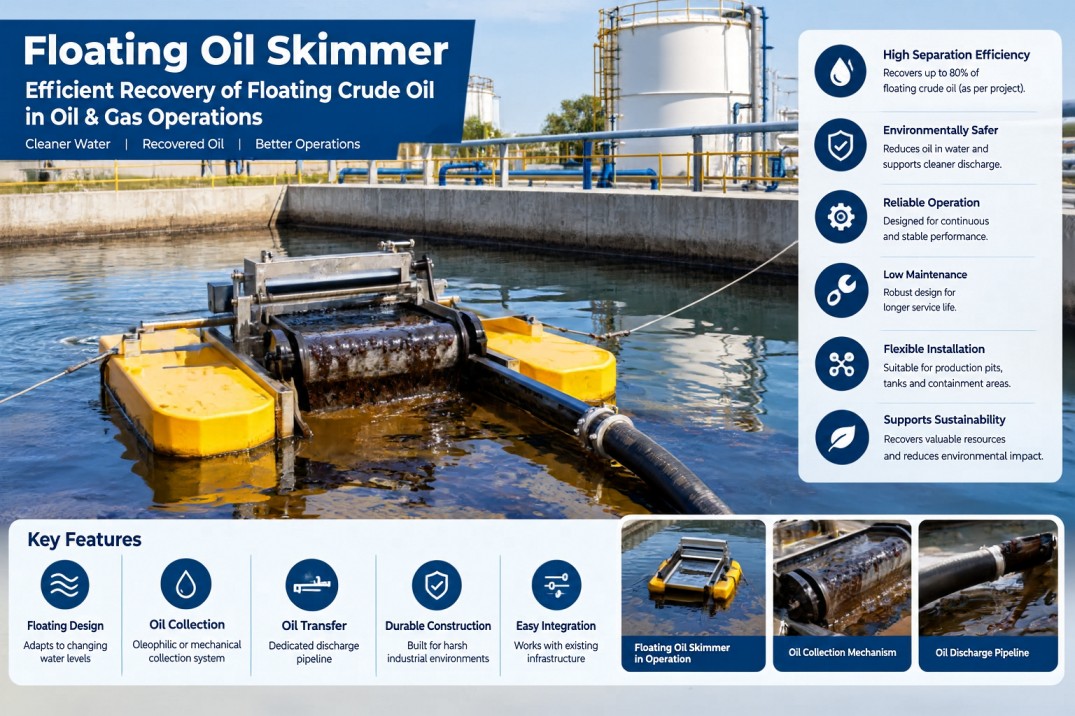
Floating crude oil in production pits presents a significant challenge for oil and gas facilities. When crude oil accumulates on the surface of water, recovering it efficiently becomes essential for reducing product loss, improving operational efficiency, and managing environmental risks.
Traditional oil recovery methods may require considerable manual intervention and can struggle with changing water levels, varying oil properties, and debris in the collection area. A floating oil skimmer offers a practical solution by collecting oil from the water's surface and transferring it to a designated recovery point.
HIS Pumps & Systems supplied and installed a floating oil skimmer to address a customer's challenge of recovering floating crude oil from a water-filled pit. The installed system achieved a reported 80% oil separation efficiency, helping improve oil recovery from the application.
A floating oil skimmer is an industrial device designed to collect oil floating on the surface of water. It is used in applications where oil accumulates in pits, tanks, sumps, wastewater collection areas, and other containment systems.
Floating oil skimmers are designed to remain positioned near the oil-water interface, allowing them to collect surface oil as water levels change.
Depending on the application, oil skimmers may use belts, discs, tubes, weirs, or other collection mechanisms. The appropriate design depends on the oil's viscosity, the thickness of the floating oil layer, water conditions, debris levels, and the required recovery rate.
In oil and gas operations, floating oil skimmers can help recover valuable hydrocarbons that would otherwise remain in collection pits or require additional separation and handling.
The customer faced difficulties collecting floating crude oil from water accumulated in a pit. Efficiently recovering the oil was important for improving resource utilisation and managing the oil-water separation process.
Several operational factors can make this type of application challenging.
Crude oil can accumulate on the surface of water in production pits and industrial collection areas. Without an appropriate recovery system, the floating layer may remain difficult to collect consistently.
Manual collection can be time-consuming and may not provide the continuous recovery needed for ongoing operations.
Water levels in industrial pits may fluctuate during normal operations. A fixed-position collection arrangement can lose effective contact with the oil layer when the surface level changes.
A floating skimmer can help address this challenge by maintaining its position relative to the water surface, depending on its design and operating conditions.
Recovering floating oil requires a collection mechanism suited to the properties of the oil and the conditions inside the pit.
The objective is to collect as much of the floating oil as practical while limiting unnecessary water pickup. Actual separation performance depends on the equipment design and application conditions.
Oil remaining in water collection systems represents a potential loss of recoverable material. Inadequate collection may also increase the burden on downstream treatment and waste management processes.
An appropriate oil skimming solution can help improve resource recovery and support better management of oil-contaminated water.
HIS Pumps & Systems installed a floating oil skimmer in the customer's pit to collect floating crude oil from the water surface.
The solution was selected to address the challenge of surface oil recovery and improve the separation process. By positioning the collection system at the oil-water interface, the skimmer could collect floating oil without relying entirely on manual recovery methods.
The installation achieved a reported oil separation efficiency of 80%, demonstrating significant oil recovery performance for the application.
Industry: Oil and gas
Application: Floating crude oil recovery from a water-filled pit
Challenge: Difficulty collecting floating oil efficiently
Solution provided: Floating oil skimmer
Product category: Oil skimmers
Reported separation efficiency: 80%
Primary objective: Improve floating oil collection and support effective oil-water separation
Supplier and installer: HIS Pumps & Systems
The reported 80% efficiency relates to the supplied project information. The precise measurement method, operating conditions, and definition of separation efficiency should be confirmed before making broader performance comparisons.
A floating oil skimmer collects oil from the surface of water using a mechanism designed to remove the floating hydrocarbon layer.
Although the operating principle varies by skimmer type, the general process involves several stages.
The skimmer is positioned in the pit so that its collection mechanism can access the floating oil layer.
A floating design can help maintain contact with the water surface as the level changes within the equipment's operating range.
The collection mechanism removes oil from the surface. Depending on the design, it may use oil-attracting materials or a mechanical collection arrangement.
Oleophilic collection surfaces, for example, preferentially attract oil and can help limit water pickup when correctly selected for the application.
The collected oil is directed to a discharge point or recovery arrangement. Depending on the installation, the recovered material may then be transferred to a suitable collection tank or downstream process.
The skimmer can continue collecting oil while operating within its design limits. Regular inspection and appropriate maintenance help maintain performance and reduce interruptions.
The overall recovery rate depends on oil properties, floating layer thickness, water conditions, equipment configuration, and the handling capacity of the downstream collection system.
Floating oil skimmers help collect oil that accumulates on the water surface. Recovering this material can reduce losses and allow suitable recovered oil to be evaluated for reuse or further processing.
In the HIS Pumps & Systems project, the installed system achieved a reported separation efficiency of 80%.
Floating designs can follow changes in the water surface, helping maintain contact with the oil layer.
This can be particularly useful in pits where water levels fluctuate during normal operating conditions.
An installed skimmer can reduce dependence on manual oil collection, depending on the degree of automation and the site's operating procedures.
This may help simplify routine recovery activities and reduce the need for repeated manual intervention.
Removing floating oil can help reduce the hydrocarbon load entering subsequent water treatment or separation stages.
The impact on downstream processes depends on the pit conditions, oil concentration, and the overall treatment system.
Recovering oil from collection pits can help improve material utilisation. The financial benefit depends on the quantity recovered, oil value, operating costs, and whether the recovered material can be reused.
Floating oil skimmers can be considered for different pit configurations, subject to equipment selection and site assessment.
Factors such as pit dimensions, access, water depth, oil accumulation patterns, and discharge routing should be evaluated before installation.
Selecting an appropriate oil skimmer requires more than identifying the presence of floating oil. Several operating conditions influence recovery performance.
Oil viscosity affects how readily the material moves toward and through the collection mechanism. More viscous oils may require a different skimmer configuration or operating approach than lighter oils.
A thicker surface layer may offer different collection conditions from a thin, dispersed oil film. The required recovery rate and expected oil accumulation should be considered when selecting equipment.
Changes in water level, pit dimensions, and surface movement can influence skimmer positioning and coverage.
The installation location should allow the collection mechanism to access the areas where oil accumulates.
Floating solids and debris may interfere with collection mechanisms or block parts of the system. Where necessary, debris management or preliminary screening should be considered.
The recovered oil must be transferred away from the skimmer at a suitable rate. An undersized downstream transfer arrangement can limit the performance of the overall recovery system.
Regular inspection, cleaning, and servicing help maintain reliable operation. Maintenance intervals should reflect the operating environment, oil characteristics, and equipment manufacturer's recommendations.
Floating oil skimmers may be suitable for a range of industrial applications involving surface oil accumulation.
Common applications include:
Oil and gas production pits.
Industrial oil-water collection pits.
Oil storage and processing facilities.
Wastewater collection and treatment systems.
Oil separation and recovery operations.
Industrial sumps containing floating hydrocarbons.
Selected environmental oil recovery applications.
The suitability of a specific skimmer depends on the oil properties, water conditions, site requirements, and intended recovery process.
Industrial oil recovery requires equipment selected according to actual operating conditions. A solution must account for the nature of the oil, the configuration of the collection area, the required recovery performance, and the method used to handle the recovered material.
HIS Pumps & Systems provides industrial pumping and oil skimming solutions for material recovery and process applications.
For this oil and gas project, the company installed a floating oil skimmer to collect crude oil floating on water in a pit. The project achieved a reported separation efficiency of 80%, addressing the customer's need for more effective oil collection.
When evaluating an oil skimmer supplier, operators should consider application experience, equipment suitability, installation requirements, maintenance support, and the ability to integrate the skimmer with existing oil collection infrastructure.
An oil skimmer removes oil floating on the surface of water in applications such as production pits, sumps, tanks, and industrial water collection systems. It helps recover oil and can reduce the amount of floating hydrocarbon entering downstream treatment processes.
A floating oil skimmer is a surface oil recovery device designed to operate near the oil-water interface. Its floating arrangement helps maintain contact with the water surface as the level changes within its operating range.
Performance depends on the skimmer design, oil characteristics, water conditions, and operating setup. In the project supplied by HIS Pumps & Systems, the reported oil separation efficiency was 80%. This figure should not be treated as a universal performance guarantee for every application.
Yes. Floating oil skimmers can be used to collect crude oil accumulating on the surface of water-filled pits, provided the equipment is suitable for the oil properties and site conditions.
Important factors include oil viscosity, oil layer thickness, pit dimensions, water level variation, debris content, required recovery rate, discharge arrangements, and maintenance requirements.
They may be suitable where oil accumulates on the wastewater surface. The skimmer should be selected according to the wastewater composition, oil properties, treatment objectives, and applicable environmental requirements.
Recovering floating crude oil from water-filled pits can be challenging for oil and gas operators, particularly when conventional collection methods do not provide the required performance.
Floating oil skimmers offer a practical approach by collecting surface oil and directing it toward a designated recovery point. When correctly selected and installed, they can help improve oil recovery, reduce manual collection requirements, and support more effective management of oil-contaminated water.
For this application, HIS Pumps & Systems installed a floating oil skimmer to collect crude oil from a pit, achieving a reported 80% oil separation efficiency.
Looking for an oil skimmer for your production pit or industrial oil recovery application? Contact HIS Pumps & Systems to discuss your operating conditions, oil recovery requirements, and suitable skimming solutions.

Writer


Reach out to us
Share your requirement with us. Out team will respond promplty

Our Journey Started in 1996 as "Harsh Industrial Services" providing Industrial Pumping Solutions to major companies in Chemical and Pharmaceutical sector across the State of Gujarat.
© HIS Pumps 2026. All Rights Reserved. | Designed & Developed by : Webyou Technologies